Why are more Indigenous babies dying and what are we doing about it?
- Lisa Baker
- Jul 2, 2019
- 5 min read
Updated: Jul 14, 2019
Infant mortality, defined as death in the first year of life, is a priority health indicator across the globe. Governments throughout the world record and report the infant mortality rate of their country, and often allocate funds to reduce it. While initiatives in Canada have reduced the country’s overall infant mortality rate over the last few decades, there are some shocking disparities within various populations (Public Health Agency of Canada (PHAC), 2018). Canada’s Indigenous babies are currently dying at rates much higher than the general population: 1.9 times higher for Metis families, 2.3 times higher for First Nations families, and 3.9 times higher for Inuit families (PHAC, 2018). In today’s post I will look at some of the factors that lead to this inequity and also highlight some of the work being done in Alberta to improve health outcomes for Indigenous infants and families.
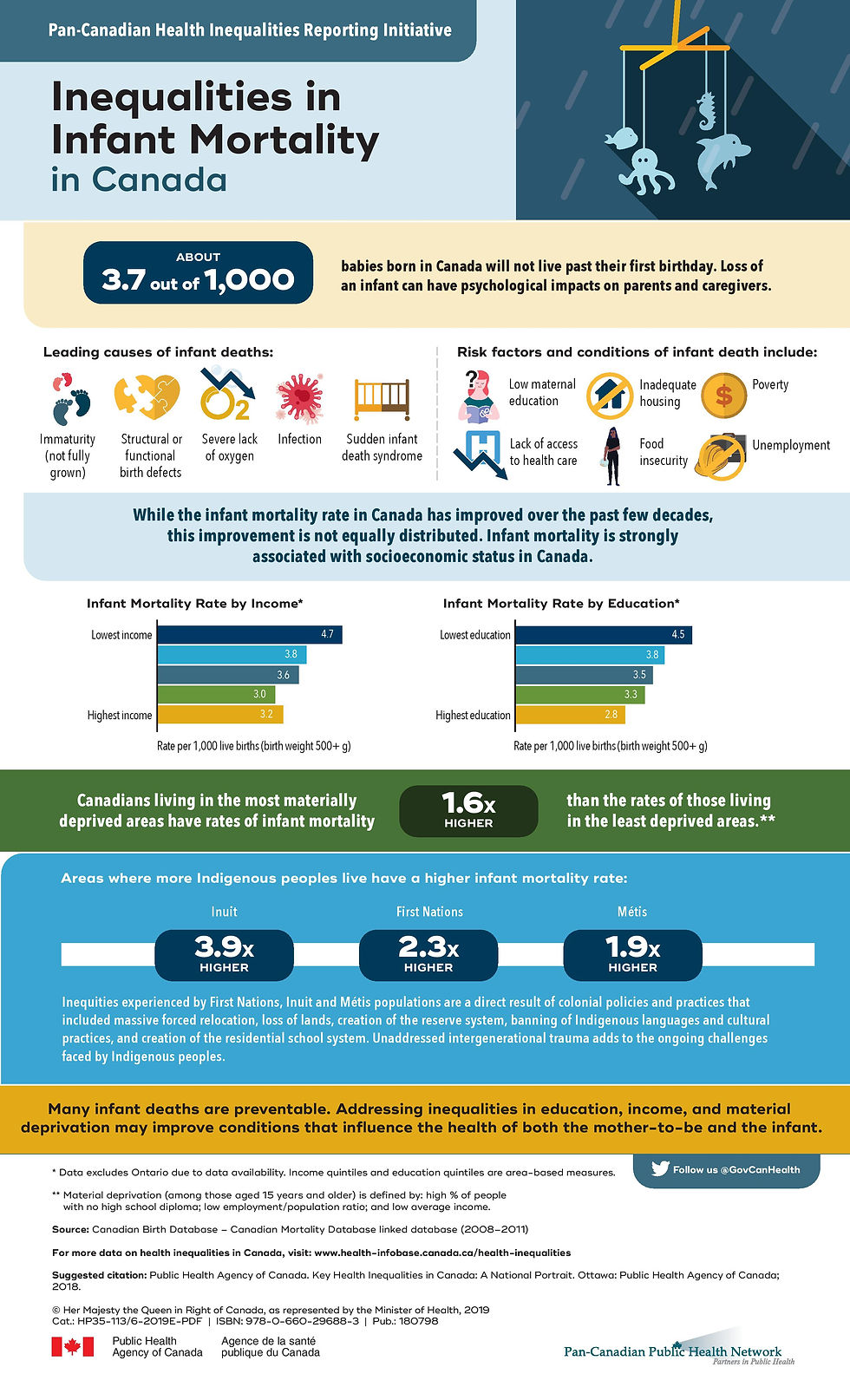
It is now commonly accepted that federal initiatives to assimilate Indigenous peoples into a Eurocentric culture has been the primary contributing factor to the health inequities experienced by Indigenous families in Canada. Initiatives such as the residential school system, segregated hospitals, and the Sixties Scoop failed to assimilate Indigenous children into a Eurocentric culture (Dart, n.d.; Hanson, 2009; and Pelley, n.d.) . Rather, it resulted in significant intergenerational trauma and a rise in substance abuse and suicide as individuals tried to deal with the trauma they faced (Centre for Suicide Prevention, n.d.). Pregnant Indigenous women have also experienced, and continue to experience, the impacts of this systemic racism through forced evacuations to give birth in hospitals far from their home without family or cultural support (Lawford, Giles, & Bourgeault, 2018). Although explicit racism is not as prevalent today, the unconscious bias of healthcare providers still results in different healthcare treatment for Indigenous families (Sterritt & Woodward, April 9, 2019). Understandably, a widespread mistrust in government institutions, and the professionals working in them, has led to a widespread fear of seeking support from providers by many in the Indigenous community.
With a history of deliberate cultural genocide of Indigenous peoples, Canada must now address the intergenerational trauma and poor health and socioeconomic outcomes caused by these practices. Bringing reconciliation to healthcare is one way to address the poor health outcomes experienced by Indigenous peoples today. In the report, Bringing Reconciliation to Healthcare in Canada, reconciliation is defined as a broad term that includes “acknowledging the wrongs of the past, knowing our true history, recognizing the inherent rights of all Indigenous peoples, and restoring balance to relationships between Indigenous and non-Indigenous peoples” (Richardson & Murphy, 2018, p. 3). The province of Alberta has taken action on bringing reconciliation to healthcare, and is starting to see improvements in the infant mortality rate of First Nations families.
Alberta Health Services (AHS) has chosen to focus on reducing the gap in perinatal mortality, defined as stillbirth and death in the first 7 days of life, experienced in First Nations and non-First Nations populations (AHS, 2018). The data does not include numbers for Inuit or Metis populations. First Nations families in Alberta have experienced rates of perinatal mortality approximately 1.5 - 2.0 times higher than non-First Nations families in the last five years. The data presented in Figure 2 indicates that the gap in perinatal mortality rates between these groups is beginning to shrink (AHS, 2018).

AHS describes the actions taken to reduce this gap in the 2017-2018 AHS Report on Performance. Some of these actions include:
use of community-based initiatives to help Indigenous families overcome the barriers to accessing prenatal care, including the provision of safe housing options, community-based mental health support, and the sharing of Indigenous knowledge related to pregnancy and birth;
development of an antenatal care pathway to ensure consistent, evidence-based care is available to all families in Alberta;
improvement of data capacity to better report on health outcomes of women and children and to provide direction for public policy; and
development of a midwifery care service model for Indigenous families.
In March of 2019, AHS reached a three-year agreement with the Alberta Association of Midwives to expand the scope of midwives and to increase access to midwifery care across the province (AHS, 2019). The agreement includes the development of a program to specifically assist midwives servicing Indigenous and underserved populations throughout Alberta. Providing midwifery care to rural and remote Indigenous communities is a crucial step in providing culturally safe health care closer to home for expectant and new mothers and their newborns (Smith, May 21, 2019).
The non-profit sector has also taken action on improving birth outcomes by building access to culturally appropriate care for Indigenous families. One organization working in this field is Indigenous Birth Alberta. Among their many efforts to renew traditional Indigenous practices is the training of birth doulas to support families throughout pregnancy, birth, and the postpartum period (Alberta Primetime, January 12, 2018). The National Aboriginal Council of Midwives is working to increase and improve local midwifery care for First Nations, Metis, and Inuit families in Alberta and across the country. Their initiatives are broad in scope, including the publication of booklets designed to share and celebrate Indigenous knowledge in pregnancy, birth, and infant care (National Aboriginal Council of Midwives, 2017). Another non-profit organization working to improve health outcomes for mothers and newborns is Immigrant Services Calgary (ISC). In partnership with Alberta Health Services, ISC helps deliver Best Beginning services to low-income families through funds from the Canadian Prenatal Nutrition Program. Although not specifically for Indigenous families, Best Beginning staff provide nutritional supplements, grocery gift cards, transportation support, and socioeconomic support to help the families they serve meet their basic needs during the prenatal period. They also provide home visitation support and facilitate group education. Indigenous Birth Alberta, the National Aboriginal Council of Midwives, and Immigrant Services Calgary are three examples of non-profit organizations working to improve birth outcomes for Indigenous families in Alberta.
The death of a young infant is an incredibly difficult experience for parents, their family and friends, and the health providers that care for them. The increased infant mortality rate in Indigenous families is not solely an Indigenous problem. Rather, it is ultimately the result of systemic racism that has taken place since the time of colonization. Families, communities, non-profit organizations, healthcare providers, and governments all have a role to play to reduce the gap in the infant mortality rate experienced by Indigenous and non-Indigenous families in Canada. Current examples from Alberta demonstrate that the concerted effort of many does have a real impact on addressing health inequity.
References
Alberta Health Services. (2018). Alberta Health Services Annual Report 2017-2018. Retrieved from https://www.albertahealthservices.ca/assets/about/publications/2017-18-annual-report-web-version.pdf
Alberta Health Services. (2019). AHS reaches three-year agreement with Alberta midwives. Retrieved from https://www.albertahealthservices.ca/news/releases/2019/Page14957.aspx
Alberta Primetime. (January 12, 2018). Cultural birth support for indigenous communities [Video file]. Retrieved from https://alberta.ctvnews.ca/cultural-birth-support-for-indigenous-communities-1.3757421
Centre for Suicide Prevention. (n.d.) Trauma and suicide in Indigenous people. Retrieved from https://www.suicideinfo.ca/resource/trauma-and-suicide-in-indigenous-people/
Dart, C. (n.d.). Birth of a Family: The Sixties Scoop Explained. CBC. Retrieved from https://www.cbc.ca/cbcdocspov/features/the-sixties-scoop-explained
Hanson, E., (2009). The Residential School System. Retrieved from https://indigenousfoundations.arts.ubc.ca/the_residential_school_system/
Lawford, K.M., GIles, A.R., & Bourgeault, I.L. (2018). Canada’s evacuation policy for pregnant First Nations women: Resignation, resilience, and resistance. Women and Birth, 31(6), 479-488. doi: https://doi.org/10.1016/j.wombi.2018.01.009
National Aboriginal Council of Midwives. (2017). Stories and Teachings about Pregnancy, Birth and Infant Care. Retrieved from https://indigenousmidwifery.ca/publications/
Pelley, L. (n.d.) Mistreated: The legacy of segregated hospitals haunts Indigenous survivors. CBC. Retrieved from https://www.cbc.ca/news2/interactives/sh/jTCWPYgkNH/mistreated/
Public Health Agency of Canada. (2018). Key Health Inequalities in Canada: A National Portrait. Retrieved from: https://www.canada.ca/en/public-health/services/publications/science-research-data/key-health-inequalities-canada-national-portrait-executive-summary.html
Richardson, L., & Murphy, T. (2018). Bringing Reconciliation to Healthcare in Canada: Wise Practices for Healthcare Leaders. Retrieved from http://www.healthcarecan.ca/wp-content/themes/camyno/assets/document/Reports/2018/HCC/EN/TRCC_EN.pdf?target=blank
Smith, K. (May 21, 2019). How Indigenous midwives help reconnect women with culture and pregnancy care. CBC. Retrieved from https://globalnews.ca/news/5296019/indigenous-midwives-alberta-women-culture-pregnancy-health/
Sterritt, A., & Woodward, P. (April 9, 2019). 'Judged and ashamed': Indigenous parents describe scrutiny, mistrust of social workers. CBC. Retrieved from https://www.cbc.ca/news/canada/british-columbia/judged-and-ashamed-indigenous-parents-describe-scrutiny-mistrust-of-social-workers-1.5059294?__vfz=medium%3Dsharebarn


Comments