Canadian perspective on the determinants of health
- Lisa Baker
- Jun 5, 2019
- 6 min read
Updated: Jul 14, 2019
This blog post is the second in a series that explores the definition of health and the factors that influence health. To gain a better understanding of the definition of health, please read my first post in the series, Defining health in the twenty-first century. In this post we will look at the broad range of factors that determine the health of the individual and the population, otherwise known as the determinants of health.
What are the determinants of health?
The Public Health Agency of Canada (2018) defines the determinants of health as the “broad range of personal, social, economic and environmental factors that determine individual and population health”. A list of determinants presented with this definition include (1) income and social status, (2) employment and working conditions, (3) education and literacy, (4) childhood experiences, (5) physical environments, (6) social supports and coping skills, (7) healthy behaviours, (8) access to health services, (9) biology and genetic endowment, (10) gender, and (11) culture. This definition aligns well with the World Health Organization’s definition of the determinants of health (2019), which includes the following categories: (1) social and economic environment, (2) physical environment, and (3) person’s individual characteristics and behaviours. What follows is a brief summary of the three categories and a collection of resources related to each. Finally, I will present a case study of a public health program in Alberta that attempts to address the social and individual determinants of health.
Social determinants of health
According to the Public Health Agency of Canada, the social determinants of health (SDOH) refer to “a specific group of social and economic factors within the broader determinants of health. These relate to an individual's place in society, such as income, education or employment” (Public Health Agency of Canada, 2018). Public discourse on the social determinants began to surge around the same time as the publication of the Ottawa Charter for Health Promotion (World Health Organization, 1986). Since that time, many academic and government institutions have attempted to define the SDOH through a series of lists, conceptual models, and narratives. Perhaps one of the best reviews of the various definitions comes from Lucyk and McLaren in Calgary, Alberta (2017). For those who prefer to view visual models, this collection of conceptual public health models includes several that address the SDOH (McDowell, n.d.).
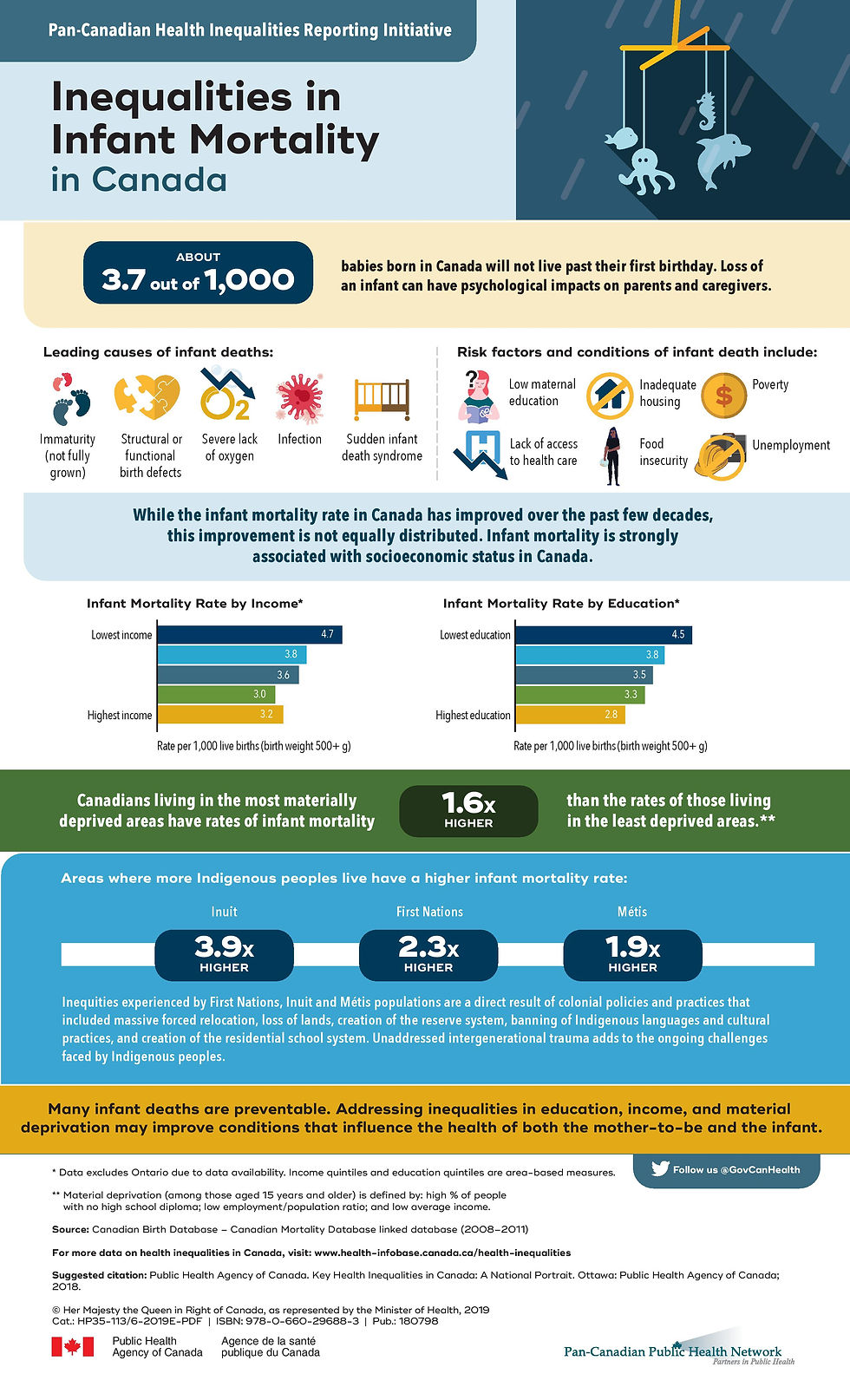
A discussion of the SDOH must include the concept of health equity. To achieve health equity, everyone is given the specific resources they need to achieve positive health outcomes. This is very different from equality, or universalism, where everyone is given the same resources without assessment or evaluation. Consider watching this great video from the Region of Halton to explore the differences between equality and equity (2016). When considering the SDOH in policy-making and program development, it is imperative to determine what specific groups need to reach health outcome goals. This method of healthcare is explored in more detail in a framework for the application of proportionate universalism by Carey, Crammond, and De Leeuw (2015). The Public Health Agency of Canada provides a number of tools to address health inequalities in our country (2018). Although they use the term inequalities, this section could more accurately be captured by the term inequities. This becomes clear when you read their definition of health inequality as “helping to give everyone the same opportunities to be healthy, no matter who they are or where they live” (Public Health Agency of Canada, 2018). Note that it says give everyone the same opportunities to be healthy, not give everyone the same resources to become healthy.
Environmental determinants of health
The environmental determinants of health are the physical surroundings of an individual as they work, play, and live. They can be further broken down into (1) natural environmental factors such as climate, elevation, and water sources; and (2) manmade or built environmental factors. To understand how manmade environmental factors can impact health outcomes, consider this example. Imagine children living in a neighborhood where there are no safe playground spaces. Instead, these children play in the nearest open space, an abandoned construction site. Children playing in this space are at a high risk of injuring themselves on the construction material that is left on the site, and consequently experience more emergency room visits than children in surrounding neighbourhoods. The increase in poor health outcomes of these children can be linked in part to the lack of safe place spaces available. Public policymakers have more control over manmade environmental factors than natural environmental factors. To support policy-making, the National Collaborating Centre for the Determinants of Health has curated a list of resources related to the built environment and health equity. This 2018 document, entitled Health equity and the built environment: A curated list , describes a total of 21 resources (9 main resources plus 12 additional resources). Together, these resources provide direction for intersectorial action on modifying the built environment to reduce health inequities.
Individual determinants of health
In their introduction to the determinants of health, the World Health Organization (2019) states that they do not believe in blaming individuals for their good or poor health outcomes. It is their belief that the social and environmental determinants of health are the primary factors responsible for the health of an individual, yet are out of the control of the individual. This belief, explained in detail in the 2008 WHO Commission on Social Determinants of Health final report, is responsible for the surge in public discourse on the determinants of health (Lucyk & McLaren, 2017). While SDOH are important to consider, scholars such as Bircher and Kuruvilla believe we must continue to examine individual factors in determining health. In their Meikerch Model of Health, Bircher and Kuruvilla. (2014) describe two individual determinants of health: (1) biologically given potential, and (2) personally acquired potential. They explain that the individual potential to achieve a state of health is a combination of biological traits determined by genetics and epigenetics and acquired traits that include “physiological, mental, and social resources” (Bircher & Kuruvilla, 2014. p.372). I agree that a careful examination of individual determinants is essential to client-centered healthcare.
Case study – Best Beginning
Scholars describe two approaches to addressing the determinants of health, as reviewed by Lucyk and McLaren (2017). These two approaches, known as upstream approaches and downstream approaches, are well differentiated in the video Introduction to Upstream (Upstream, 2013). Thought leaders at agencies such as the Institute for a Healthy Society believe that upstream approaches are the best way to address determinants of health (Upstream, 2013). I would agree that large intersectoral policy initiatives are critical to preventing future inequities related to the unequal distribution of the determinants of health. However, Carey, Crammond, and De Leeuw (2015) explain that downstream approaches are also needed to help address current inequities, closing today's gap between the health outcomes of those with the poorest health outcomes and highest health outcomes.
The program that I work for, Best Beginning, is one example of a downstream approach that aims to address maternal and newborn health inequities. It is also an example of proportionate universalism in action. Under the umbrella of Public Health, which provides universal healthcare to expectant parents and their children, Best Beginning offers enhanced services to expectant parents that are living in low-income households. Best Beginning clients are provided with additional group education sessions related to healthy pregnancies, opportunities to build social networks with other expectant parents in their neighbourhoods, and access to social workers who help clients connect with community social support programs such as food and housing programs. Our program is currently working on a health equity impact assessment to ascertain the unintended positive and negative impacts we are having on the various sub-groups that exist under the larger category of low-income clients.
Summary
To gain an understanding of healthcare in Canada, one must look beyond the definition of health and attempt to understand the determinants of health. Individual, social, and environmental factors, and interactions between these factors, shape the health of individuals and populations. Unequal distribution of these determinants can result in health inequities. Representatives from all levels of government, healthcare, education, and other institutions must come together to measure the impact of these factors and to develop strategies to enhance positive health outcomes for all.
References
Bircher, J., & Kuruvilla, S. (2014). Defining health by addressing individual, social, and environmental determinants: New opportunities for health care and public health. Journal of Public Health Policy, 35(3), 363–386. https://doi.org/10.1057/jphp.2014.19
Carey, G., Crammond, B., & De Leeuw, E. (2015). Towards health equity: a framework for the application of proportionate universalism. International Journal for Equity in Health, 14(81). https://doi.org/10.1186/s12939-015-0207-6
Health Canada. (2018). Social determinants of health and health inequalities. Retrieved from https://www.canada.ca/en/public-health/services/health-promotion/population-health/what-determines-health.html
Lucyk, K., & McLaren, L., (2017). Taking stock of the social determinants of health: A scoping review. PLoS ONE, 12(5). https://doi.org/10.1371/journal.pone.0177306
McDowell I. (n.d.). Index of Conceptual Models of Population Health. In Society, the individual, and medicine course notes. Retrieved June 3, 2019, from http://www.med.uottawa.ca/sim/data/Models/Default_models_e.htm
National Collaborating Centre for Determinants of Health. (2018). Health equity and the built environment: A curated list. Retrieved from http://nccdh.ca/resources/entry/health-equity-and-the-built-environment-a-curated-list
Region of Halton. (2016). Cover all the bases with Health Equity Impact Assessment (HEIA). Retrieved from https://www.youtube.com/watch?v=9GcgpGzqEDQ
Upstream. (2013). Introduction to Upstream. Retrieved from https://www.youtube.com/watch?v=qarQXqKbmLg&feature=youtu.be
World Health Organization. (2019). The determinants of health. Retrieved from https://www.who.int/hia/evidence/doh/en/
World Health Organization. (1986). Ottawa Charter for Health Promotion: First International Conference on Health Promotion Ottawa, 21 November 1986. Retrieved from https://www.who.int/healthpromotion/conferences/previous/ottawa/en/


Comments